Student Reflections on Yeshiva Options Week
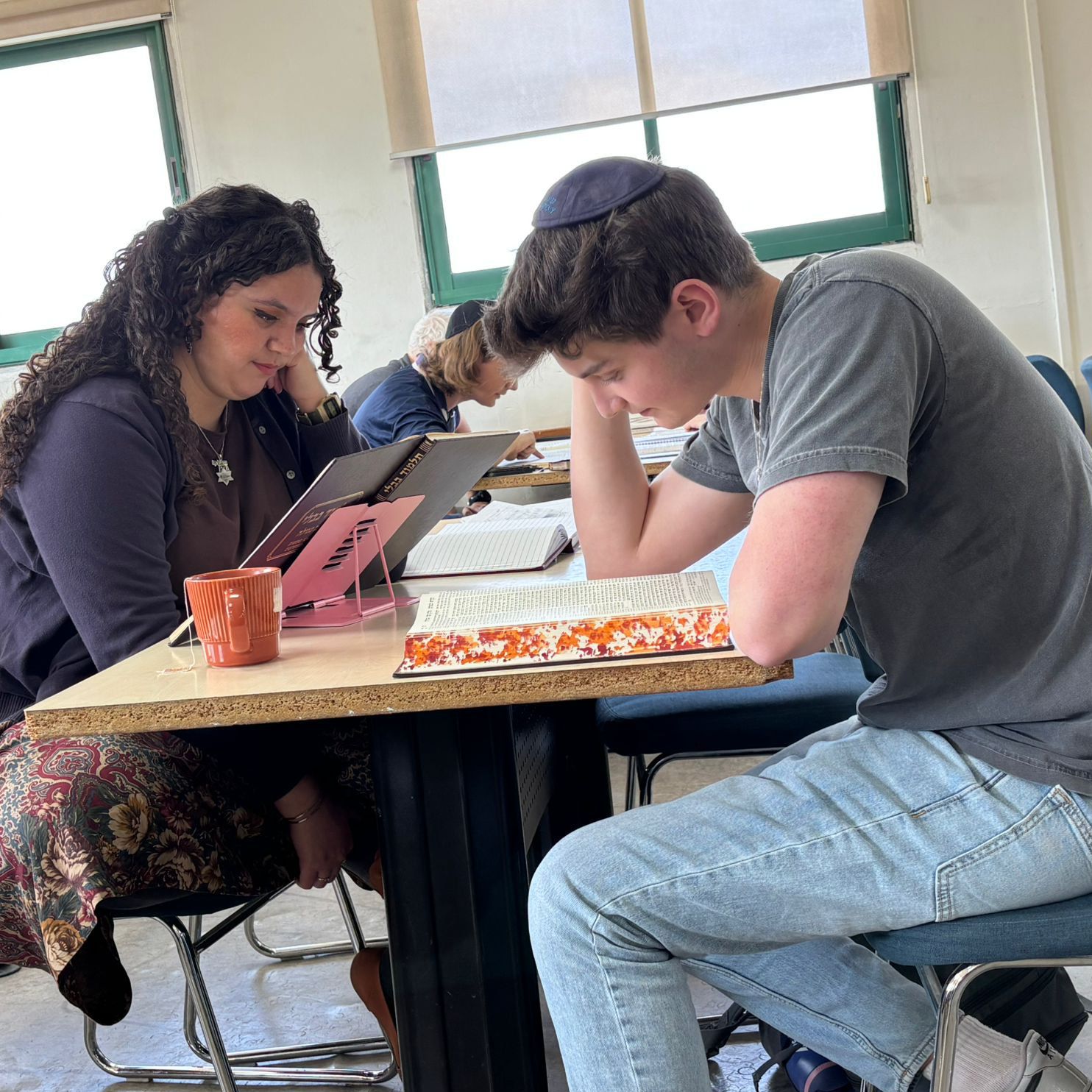
Last week, “Options Week,” I opted to spend five days at the Pardes Institute, a yeshiva in Jerusalem. We learned from the second chapter of Masechet Megillah in the Babylonian Talmud, in preparation for
Purim this week. Here’s a little bit of what I learned.
The Mishnah discusses how the rules for Purim change, depending on where you are observing it. In cities without walls, which is most of the world, you are supposed to observe Purim on the fourteenth of Adar. However, in walled cities – including Jerusalem – Purim is on the fifteenth, commemorating the fact that the fighting in the walled city of Shushan extended for an extra day. The first half of this Mishnah wants to know what happens if someone from one kind of city visits another – should you celebrate Purim with everyone there, or on the specified day of your hometown? The Mishnah states that the answer depends on the following question: are you staying there for good, or just visiting?
The second half of this Mishnah pivots to a discussion of the content of the reading itself. The Rabbis ask: do you really have to read the whole Megillah, or can you start from the middle somewhere? And if so, where? The Mishnah proposes three opinions: that you must start from the beginning, that you may start from chapter two, and that you may start from chapter three. Later, the Gemara adds the opinion that you may start from chapter six.
It became clear as I studied that the Mishnah is really asking – who is the main character of Purim? Is it Achashveirosh, who is described in the very beginning of the Megillah, or Mordechai, introduced in the second, or Haman, in the third, or “the miracle,” a fitting way to describe the hidden influence of G-d, which starts in the sixth chapter?
This machloket is a proxy argument over the meaning of Purim. Purim is a holiday about Jewish life in exile, and the accompanying challenges, triumphs, and absurdities. The Rabbis are really asking: what is the main challenge of exile? Is it Achashveirosh, who represents the reality of national subjugation and the Jews’ lack of sovereignty? Is it Mordechai, the difficulty of preserving our Jewish identity? Is it Haman, antisemitism? Or is it “the miracle,” the hiddenness of G-d? The sugya in the Gemara ends with a statement that we must read the entire Megillah, perhaps an indication that all four of these challenges are real, and each is central to the story of Purim.
After learning this sugya, our teacher asked us what we thought was the connection between the first and second halves of the Mishnah. What do the laws of travelling between different kinds of cities have to do with the obligation to read the entire (or only certain parts of) the Megillah?
The answer, he suggested, lies in the criteria the Rabbis use to determine which town’s rules you should follow. It’s about whether you are staying there for good, or just visiting. Whether that place is your new home, or you are still a little bit homesick, still yearning to return somewhere. For the Rabbis, this question was also a central question of Purim, which put into focus all of the challenges they identified in the Megillah corresponding to life in exile. Are you there for good, or are you still a little bit homesick, longing to return to Eretz Yisrael, your true home?
This teaching hit me hard, because I am confused about where my home is right now. I’ve lived since I was two in White Plains, New York. Whenever I travel anywhere else, I get homesick. I’m a little bit homesick right now. And yet, three weeks ago, after hours of flying and torturous hassles in customs after a week in Poland, stepping out of the bus into Jerusalem felt a lot like returning home. Eating in restaurants without worrying about kashrut, shouting “Shabbat Shalom” to strangers across the street, and learning Gemara in a yeshiva has felt like home too.
In Poland, we saw a beautiful mural in the Warsaw cemetery. On one side was a heartbreaking depiction of the destruction of the First Temple. On the other, a glorious portrait of a vast Jewish city. I guessed that the city was a vision of a restored Jerusalem, after the coming of the messiah, the return of the Jews, and the rebuilding of the Holy Temple. In fact, this side of the mural was simply a depiction of Jewish civilization in Warsaw. The Jews of Warsaw had built a thriving, expansive society. They earnestly believed Warsaw was their home, their New Jerusalem.
As we learned during our week in Poland, the Jews of Warsaw were wrong. Their civilization was demolished. Today, there are likely fewer than twenty thousand Jews in all of Poland. Everywhere we went, there were beautiful synagogues and yeshivas, majestic monuments and vast cemeteries, and almost no Jewish communities to animate them. The country did not feel like home.
I don’t know if it is possible for Jews to feel at home anywhere in the world after witnessing the horrors of the Holocaust. I feel safe in America, but I also feel changing currents that make me afraid, moving in directions that I can’t predict and am powerless to stop. White Plains has been a wonderful home to me so far, but I cannot banish from my mind the second side of that mural, the beautiful, vast, majestic, and no-longer-existent Jewish civilization of Warsaw.
To complicate things even further, a few months after I get back to America, I’ll be packing my things to go to college in another state. Where will my home be then? Will it be White Plains, where my parents are? Will it be my dorm room? Will it be the Hillel and the Chabad on campus? Will it be Eretz Yisrael, the homeland of my people? I don’t know the answer to this question. I think this is what adolescence is about: wrestling with this question, and developing compelling and contradictory answers.
I think this is what the Rabbis wanted Purim to be about, too. Living in Babylonia, travelling between walled and unwalled cities, reading a book about life in Persia, pining to return to Eretz Ysrael. They didn’t know where their homes were, either. Megillat Esther is a satire. It’s making fun of us a little bit. None of us know where we’re going, and none can predict the course of events in a world with a hidden G-d. The best we can do is celebrate another year of survival, hope for peace, and try to enjoy our triangular pastries filled with jam.